
The history of the word "Mezzaro"
Updated: Sep 14
The word mezzaro has a long and fascinating history spanning centuries, languages and cultures. Exploring its origins means tracing the history of a garment that was a key part of women's wardrobes for centuries, particularly in Genoa.
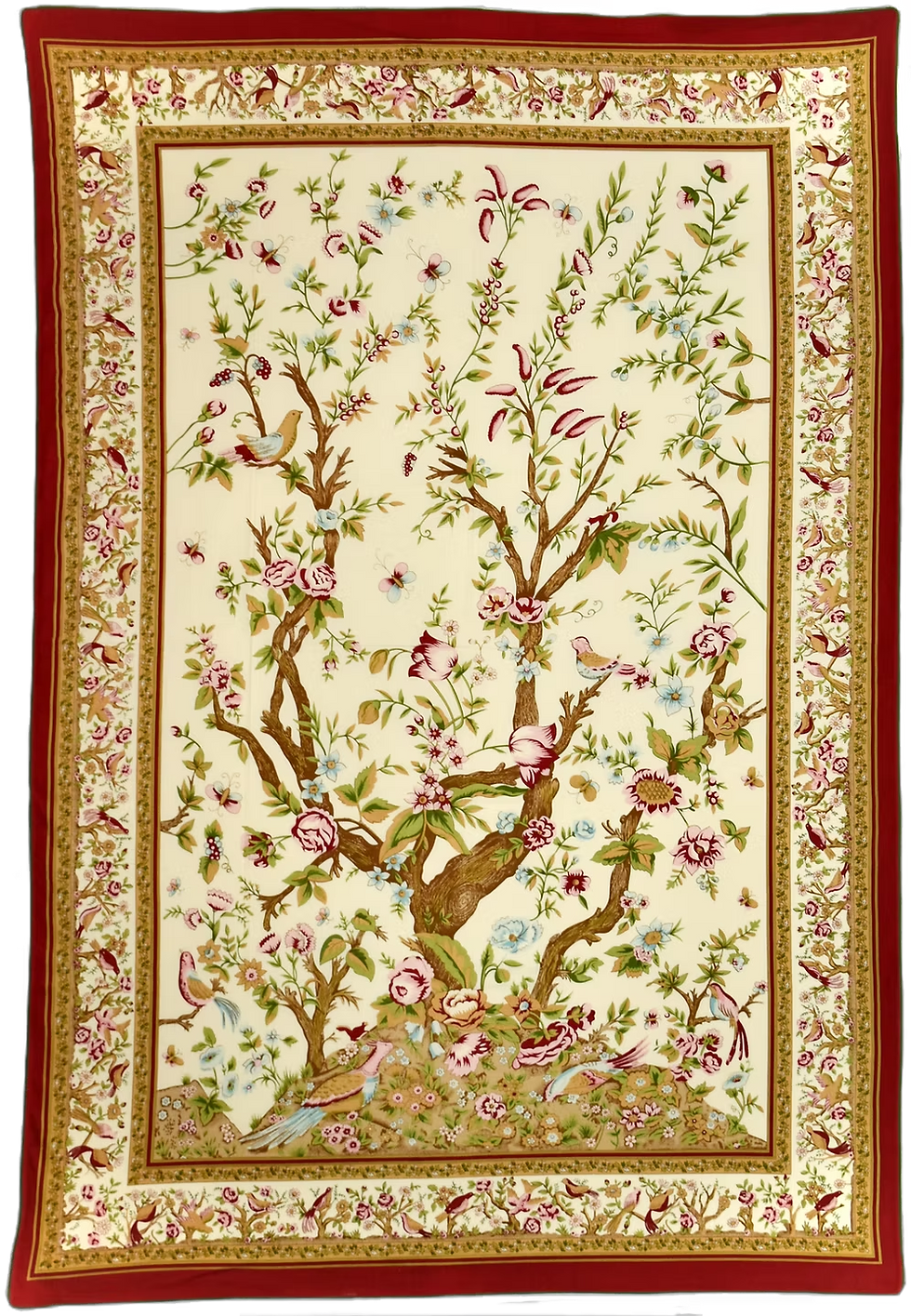
Etymology: from the Arabic mi'zar
The most widely accepted etymology today traces mezzaro back to the Arabic word mi'zar, which referred to a veil or cloth used to cover the head or body. Numerous variants recorded in Mediterranean dialects derive from this root: mizar, mezar, meiero, mezzero.
Other theories were suggested in the past, such as a link with the Italian word mezzo (half) or with the Arabic verb sarra ("to cover, to wrap"), but documentary evidence has led scholars to favour an origin in mi'zar.
The earliest records
One of the earliest accounts in Italy dates back to 1517, in the travel journal of Antonio De Beatis, secretary to Cardinal Luigi d'Aragona, who described the clothing of women across Italy and Europe.
During the 17th century the term became established in the Genoese vocabulary. Inventories of bridal trousseaux list mezzari of silk, linen and cotton, distinguished by quality and size.
Documents from 1666 and 1668 show that the mezzaro was already widespread, not only among noblewomen but also among women of the middle and working classes. An inventory from 1676 explicitly lists "a crimson satin combing cape" (pettinera) together with a taffeta mezzaro.
The golden age: the 18th century
The mezzaro reached its greatest popularity in the 18th century. The sources are plentiful: inventories, wills, travellers' descriptions, engravings and prints record its presence in every level of Genoese society.
The most important accounts include:
Carlo Giuseppe Ratti, Descrizione delle pitture, sculture e architetture (1780)
Giuseppe Bratti, Le Donne di second'Ordine (1767)
The manuscript by Giacomo Casanova (1767)
The account by P. De La Lande (1768)
Genoese women wore the mezzaro in different ways depending on the occasion: folded over the head for visits, draped over the shoulders on more formal occasions, and wrapped completely around the body for religious services.

The mezzaro in period prints
Engravings of the time offer a vivid glimpse of 18th-century Genoa. The views by A. Gualli (1749), showing Strada Nuova, Piazza Annunciata and the Palazzo del Duca d'Oria and kept in the collections of the Cassa di Risparmio di Genova e Imperia, show the mezzaro as an ever-present feature of the city streets.
The fashion also drew attention outside Italy: the famous engravings after J.B. Greuze, published in the Cabinet des Estampes in Paris in 1768, depict a Genoese lady with a warm mezzaro over her head and a townswoman of Genoa with the mezzo over her head, evidence of Europe's curiosity about this distinctive garment.
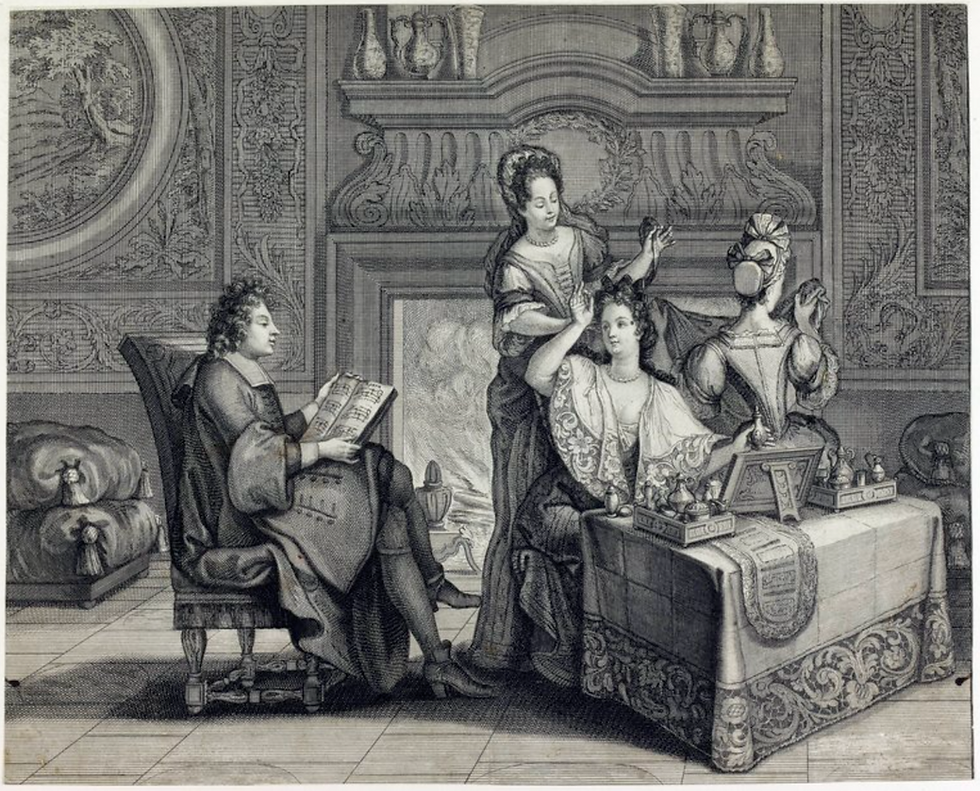
A work of particular interest, Femme de qualité à sa toilette (Paris, c. 1680, Bibliothèque Nationale), shows the mezzaro as part of a lady's toilette of the period.
The fabrics: between the East and the Mediterranean
Archival research shows that many of the printed fabrics used for mezzari reached Genoa along the trade routes with the East, especially from Indian workshops already renowned in the 16th century for the quality of their block printing on cotton.
From 1731, and more systematically from 1768, some European manufacturers, particularly French ones, began producing fabrics that imitated Eastern motifs and techniques. From its very beginnings, the mezzaro was born at a crossroads of traditions: ancient printing techniques, decorative motifs that crossed continents, and craft skills that evolved from one generation to the next.
An object that has crossed the centuries
The mezzaro also survived the 19th century and the upheavals of industrial fashion. Today the word refers not only to the historical garment but to a whole textile tradition that continues to be revisited and reinterpreted.
Knowing the history of this word means discovering an object that carries five centuries of history: of languages that met, of hands that worked it, of women who wore it, generation after generation.


Comments