
From India to Italian homes
Il Mezzaro was born from a love of hand-printed cottons and an encounter with the ancient textile traditions of India, discovered through years of travel across the subcontinent.
For over 25 years, our family has run a store in the heart of Rome, at Viale Parioli 21, where every day we express this passion through fabrics, drapes, and clothing that combine Italian design with Indian craftsmanship.
Every piece in our collections—mezzari, tablecloths, curtains, kaftans, kimonos, bedspreads—is the result of an ongoing dialogue between two cultures: Italian aesthetic sensibility and the age-old wisdom of India's block-printing artisans.

Mezzaro: a word that tells centuries of history

The word "Mezzaro" — which entered the Genoese dialect from the Arabic mi'zar (veil, covering) via the Mediterranean trade routes — indicates a large decorative cloth that, since the eighteenth century, aristocratic Ligurian families have used as a shawl, bedspread, parade drape, sofa cover, or tablecloth for special occasions.
Its roots lie in trade between the Mediterranean and the East: Genoese merchants imported the famous palampores from India, large fabrics painted or hand-printed with naturalistic motifs. Fascination with those bright colors and richly symbolic designs—the Tree of Life above all—inspired 18th-century Genoese artisans to produce local versions, giving rise to the Mezzaro as we know it today.
A Mezzaro is more than just a fabric: it's a story of cultural exchange, trade routes, and artistic reinterpretation. In Genoa, ladies of the time used it as a head veil, but in Italy and Europe, the Mezzaro also profoundly influenced home furnishings, adapting the original motifs to the tastes of their customers. Mezzaro are still produced in India using ancient printing techniques with hand-inlaid wooden blocks. The Tree of Life motif—a tree growing from a flowering hill and branching out into a rich tangle of flowers and leaves—is the central theme of the classic Mezzaro, a symbol of joy and abundance, and remains the underlying theme of our collections today.
Learn more on the blog: The history of the word Mezzaro
India: The Cottons That Changed Europe
Between the 17th and 19th centuries, printed or hand-painted cottons from India—called Indienne in Europe—triggered a true revolution in taste.
Initially considered "ordinary" and used for bedspreads or to dress the lower classes, they quickly became the attire of ladies of rank. Daniel Defoe, in 1708, wrote that chintzes had passed "from the floors to the shoulders, from footcloths to petticoats."
Their allure lay in the brilliance and solidity of their colors, qualities that European dyes of the time could not replicate. The first examples arrived in Europe aboard ships carrying mainly spices. Those voyages created a cultural fusion that inspired manufacturers across the continent—and in Genoa, it gave rise to Mezzaro.
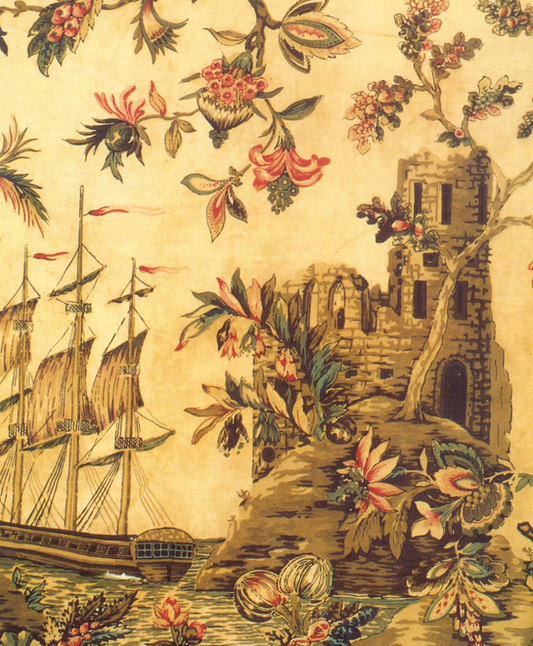
Learn more on the blog: India in Europe: How Indian cotton gave rise to the Mezzari
Block Printing: The Art of Hand Printing

In India, hand-weaving and hand-printing aren't just techniques: they're a philosophy. Every gesture of the artisan is repetition, meditation, and a dialogue with the fabric.
Nowadays, mass production, at ever-decreasing costs, has reduced the production of hand-printed fabrics—with the exception of rare artisans—to a relic of the past. Fortunately, in India, despite modern economic and technological development, artisanal traditions, merging with a philosophy of life, remain rooted in social life and thus resist change and globalization.
Even today, in some villages of Rajasthan and Gujarat, artisans produce our fabrics using the same centuries-old technique: block printing. The process is entirely manual and requires months of work to create even a single complex pattern.

The stages of processing
1. Block Carving — Master carvers carve blocks of teak wood (one block for each color of the pattern), reproducing every tiny detail of the design by hand.
2. Fabric Preparation — Natural cotton is washed, bleached, and laid out on long, padded printing tables.
3. Manual printing — The artisan dips the block of dye into the natural dye and prints it onto the fabric, repeating the process thousands of times with absolute precision. Each color requires a different block and a separate application.
4. Fixing and finishing — The fabric is dried in the sun, fixed with natural dyes, and finally hand-finished with matching cords or printed edges. The small imperfections that sometimes appear on our fabrics are not defects: they are the hallmark of authentic craftsmanship, the guarantee that each piece is truly unique.
Learn more on the blog: India: The Philosophy of Weaving
In Rome for over 25 years
It all began with our parents' love of hand-printed cottons and their desire to bring the authentic beauty of Indian textile craftsmanship to Italy. Our passion for printed cottons stemmed from our encounter with the ancient traditions of fabric printing—hand block printing—which we learned about through numerous travels to the East, and particularly to India.
More than 25 years have passed since that first trip, during which we have built relationships of trust with master craftsmen, shared ideas and projects with them, and learned to recognize every detail of their art.

Today, our store at Viale Parioli 21, Rome, is the meeting point of two worlds: the traditional Indian world, where each piece is slowly printed with wooden blocks, and the Italian world, where each collection is designed to elegantly integrate into contemporary homes. Every Mezzaro, every tablecloth, every kaftan you find in the store or on our website is the result of a journey: it begins as an idea in Rome, takes shape by hand in India, and returns to Italy to be delivered to those who know how to appreciate it.
